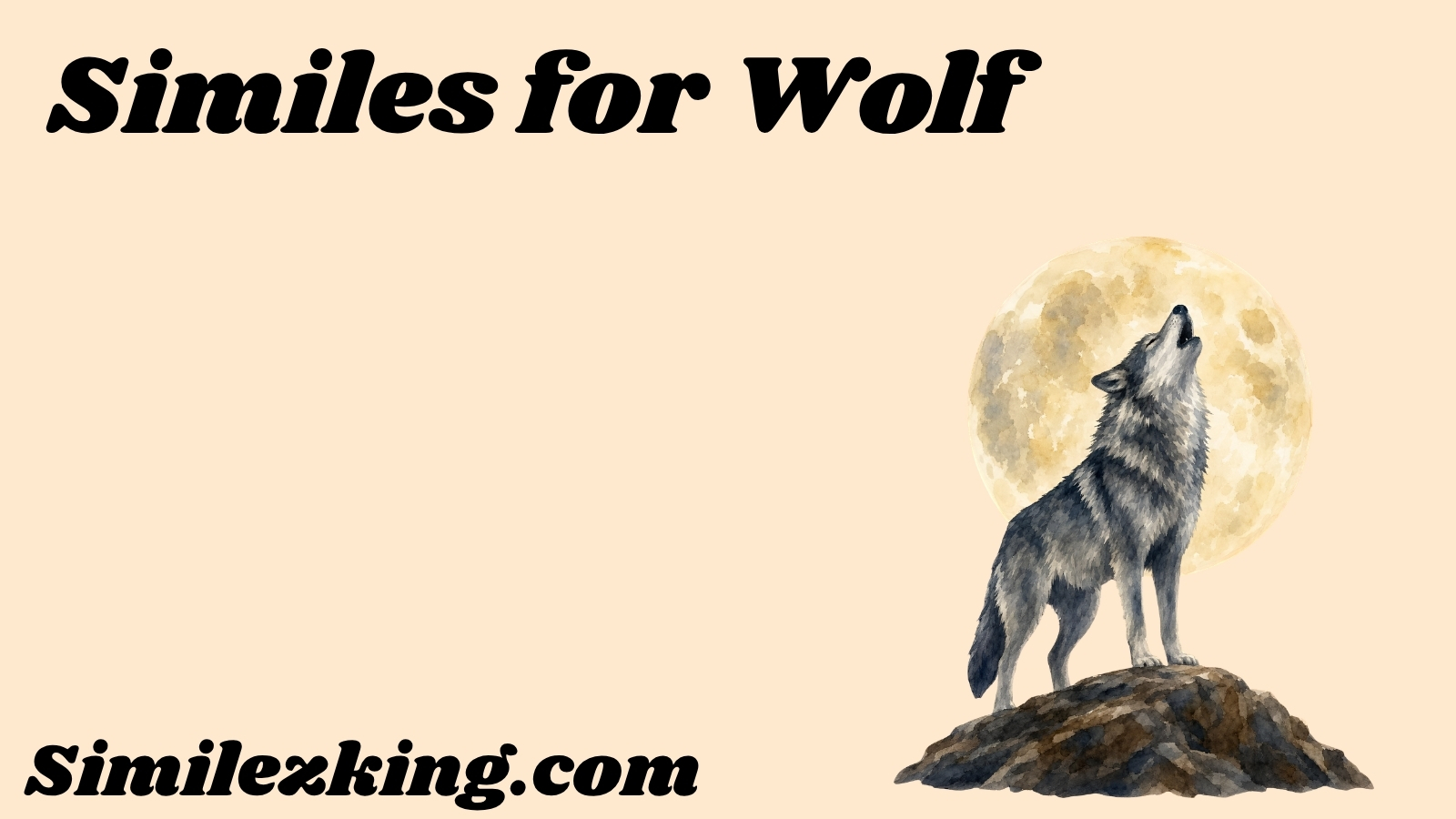
Have you ever watched a wolf move through a forest and wondered how to describe it without simply saying it is wild, strong, or scary? A good simile can turn that ordinary description into a vivid picture.
For example, instead of writing “The wolf was fast,” you could say, “The wolf was as fast as an arrow.” Suddenly, the reader can almost see the animal racing through the trees.
In this guide, you’ll discover 20+ similes for wolf that can help you describe a wolf’s appearance, speed, strength, sounds, behavior, and mysterious nature. These comparisons are useful for creative writing, short stories, poems, school assignments, descriptive paragraphs, and even character development.
Whether you are a student looking for an interesting sentence or a writer building a dramatic wilderness scene, these wolf similes will give your writing sharper images and stronger emotion. 🐺🌲
What Is a Simile for Wolf?
A simile for wolf compares a wolf or one of its qualities to something else using words such as like or as.
For example:
- The wolf was as silent as falling snow.
- The wolf moved like a shadow through the forest.
The wolf itself is not literally a shadow or falling snow. The comparison helps readers imagine its quiet, mysterious movement.
Why Use Wolf Similes?
Wolf similes can make writing:
- More descriptive
- More emotional
- Easier to visualize
- More interesting to read
- Stronger in creative storytelling
- More expressive in poetry and essays
25+ Similes for Wolf
Here is a collection of creative similes you can use or adapt for your own writing.
| # | Simile for Wolf | Meaning |
|---|---|---|
| 1 | Like a shadow in the forest | Quiet, mysterious, and difficult to notice |
| 2 | As fast as an arrow | Extremely quick |
| 3 | As silent as falling snow | Almost completely quiet |
| 4 | Like a ghost in the darkness | Mysterious and difficult to see |
| 5 | As fierce as a storm | Powerful and frightening |
| 6 | Like a silver streak through the trees | Moving quickly and gracefully |
| 7 | As hungry as a starving traveler | Extremely hungry |
| 8 | Like a knife cutting through the wind | Moving sharply and quickly |
| 9 | As wild as the wilderness | Untamed and free |
| 10 | Like a dark cloud beneath the moon | Mysterious and intimidating |
| 11 | As alert as a watchman | Always aware of its surroundings |
| 12 | Like a ghost slipping between trees | Moving quietly and mysteriously |
| 13 | As strong as an oak tree | Powerful and physically strong |
| 14 | Like a flame racing through dry grass | Moving rapidly |
| 15 | As cold as winter night | Suggesting a cold or chilling presence |
| 16 | Like thunder with four paws | Powerful and dramatic |
| 17 | As sharp-eyed as a hawk | Having excellent awareness or vision |
| 18 | Like a king ruling the wilderness | Confident, commanding, and powerful |
| 19 | As restless as a restless wind | Unable to stay still |
| 20 | Like a dark arrow across the snow | Fast and striking against a pale background |
| 21 | As watchful as a guardian | Carefully observing everything nearby |
| 22 | Like a whisper carried by the wind | Very quiet and difficult to detect |
| 23 | As graceful as a dancer | Moving smoothly and elegantly |
| 24 | Like a storm gathering on the horizon | Suggesting approaching danger |
| 25 | As lonely as a moonlit road | Creating a feeling of isolation |
| 26 | Like a silver ghost beneath the moon | Pale, mysterious, and elusive |
| 27 | As determined as a mountain climber | Strongly focused on reaching a goal |
| 28 | Like lightning across the valley | Extremely fast and energetic |
Detailed Wolf Similes With Example Sentences
1. Like a Shadow in the Forest
Meaning: The wolf is quiet, hidden, and difficult to notice.
Example:
The wolf moved like a shadow in the forest, disappearing whenever the moonlight faded.
2. As Fast as an Arrow
Meaning: The wolf is extremely quick.
Example:
The wolf ran as fast as an arrow, racing across the snowy field.
3. As Silent as Falling Snow
Meaning: The wolf makes almost no sound while moving.
Example:
The gray wolf approached as silently as falling snow.
4. Like a Ghost in the Darkness
Meaning: The wolf appears mysterious and almost unreal.
Example:
A wolf appeared like a ghost in the darkness beyond the campfire.
5. As Fierce as a Storm
Meaning: The wolf seems powerful, aggressive, or frightening.
Example:
The wolf stood as fierce as a storm, guarding its territory.
6. Like a Silver Streak Through the Trees
Meaning: The wolf moves quickly and beautifully.
Example:
The white wolf flashed like a silver streak through the trees.
7. As Hungry as a Starving Traveler
Meaning: The wolf is extremely hungry.
Example:
After wandering for hours, the wolf was as hungry as a starving traveler.
8. Like a Dark Cloud Beneath the Moon
Meaning: The wolf creates a mysterious or threatening image.
Example:
The black wolf stood like a dark cloud beneath the moon.
9. As Wild as the Wilderness
Meaning: The wolf represents freedom and untamed nature.
Example:
His spirit was as wild as the wilderness, refusing to be controlled.
10. Like Thunder With Four Paws
Meaning: The wolf’s movement or presence feels powerful and dramatic.
Example:
The huge wolf charged forward like thunder with four paws.
🐺 Fun and Creative Wolf Similes
If you’re writing a fantasy story, poem, or imaginative paragraph, try these more unusual comparisons:
- The wolf howled like a lonely singer beneath the stars.
- Its eyes glowed like two lanterns in the dark.
- The wolf ran like lightning over the frozen ground.
- Its fur shimmered like moonlight on fresh snow.
- The pack moved like a dark river through the valley.
- Its howl rose like a lonely bell across the mountains.
- The wolf watched the camp like a silent guardian.
- Its paws touched the snow like soft brushes on white paper.
These comparisons do more than describe an animal. They create an atmosphere.
🏫 Wolf Similes for School and Classroom Writing
Students can use simple wolf similes in descriptive writing, essays, stories, and poetry.
Easy Examples
- The wolf was as quiet as a mouse.
- The wolf ran like lightning.
- Its fur was as white as snow.
- The wolf’s eyes shone like stars.
- The wolf howled like a lonely singer.
- The animal moved like a shadow.
- The wolf was as alert as a guard.
- The pack traveled like a moving river.
Example Paragraph
The gray wolf stepped carefully through the forest. It moved like a shadow, making hardly any sound. Its eyes shone like two small stars beneath the moonlight. Suddenly, it ran as fast as an arrow toward the distant hills. For a moment, it looked like a silver streak through the trees.
Notice how the similes make the paragraph more visual without making the vocabulary unnecessarily difficult.
📖 Mini Story: The Wolf Beneath the Moon
The forest was quiet when Daniel heard a strange sound.
Awooooo!
He stopped walking.
Between the tall pine trees stood a gray wolf. Its fur glowed like silver beneath the moon. The animal did not move. It simply watched him.
Then, without warning, the wolf stepped backward.
It disappeared like a shadow in the forest.
Daniel followed the movement with his eyes, but he could no longer see it. A moment later, the wolf appeared on a distant ridge, running as fast as an arrow.
Its howl echoed through the valley like a lonely bell.
Daniel smiled.
He had expected the wolf to be frightening. Instead, it seemed mysterious, free, and completely at home in the wilderness.
That night, he understood something: sometimes the wildest creatures are not meant to be captured or controlled. They are meant to be admired from a distance.
✍️ How to Use Wolf Similes in Your Writing
A simile works best when it supports the scene rather than simply being added for decoration.
Step 1: Decide What You Want to Describe
Are you describing the wolf’s:
- Speed?
- Strength?
- Appearance?
- Sound?
- Eyes?
- Movement?
- Personality?
- Relationship with nature?
Step 2: Choose an Appropriate Comparison
For example:
Speed → like lightning
Silence → like falling snow
Mystery → like a ghost
Strength → like an oak
Grace → like a dancer
Step 3: Put It Into a Natural Sentence
Instead of:
The wolf was fast.
Try:
The wolf raced like lightning across the valley.
The second sentence gives the reader a much clearer mental picture.
🎯 Create Your Own Wolf Similes
Now it is your turn!
Use these patterns to create original comparisons:
Pattern 1: Like + Noun
The wolf moved like a ________.
Example:
The wolf moved like a drifting cloud.
Pattern 2: As + Adjective + As
The wolf was as ________ as ________.
Example:
The wolf was as quiet as midnight.
Pattern 3: Sensory Description
Think about what the reader can:
- See
- Hear
- Feel
- Imagine
Example:
Its howl sounded like a distant trumpet across the mountains.
Try creating three of your own:
- The wolf’s eyes were like __________.
- The wolf ran as fast as __________.
- The wolf’s howl sounded like __________.
🎮 Interactive Activity: Match the Simile
Match each wolf simile with the quality it describes.
| Simile | Quality |
|---|---|
| Like a shadow | A. Speed |
| As fast as an arrow | B. Silence |
| As strong as an oak | C. Strength |
| Like a ghost | D. Mystery |
| As graceful as a dancer | E. Movement |
Answer:
1 → B
2 → A
3 → C
4 → D
5 → E
📝 Wolf Simile Worksheet
Fill in the blanks with a creative comparison.
- The wolf moved like __________.
- Its eyes shone like __________.
- The wolf was as quiet as __________.
- Its howl sounded like __________.
- The wolf ran as fast as __________.
- Its fur looked like __________.
- The pack moved like __________.
- The wolf stood as still as __________.
Challenge Question
Write one complete sentence containing two different similes.
Example:
The wolf moved like a shadow and ran as fast as lightning.
🧠 Quick Quiz
1. Which simile best describes speed?
A. Like a ghost
B. As fast as an arrow
C. As quiet as snow
D. Like a dark cloud
Answer: B
2. Which simile creates a mysterious image?
A. Like a ghost in the darkness
B. As strong as an oak
C. As fast as an arrow
D. Like a flame
Answer: A
3. Which comparison suggests strength?
A. Like a whisper
B. Like falling snow
C. As strong as an oak
D. Like a shadow
Answer: C
⚠️ Common Mistakes When Using Wolf Similes
Even a creative comparison can become weak if it is used incorrectly.
1. Using Too Many Similes
Don’t fill every sentence with a comparison.
Too much:
The wolf was like a shadow, like lightning, like a ghost, like thunder, and like a storm.
Better:
The wolf moved like a shadow, then suddenly raced across the valley like lightning.
2. Choosing an Unclear Comparison
Your reader should understand the connection.
Instead of using a random object, choose something that clearly communicates speed, silence, strength, or another quality.
3. Forgetting the Purpose
Ask yourself:
What does this simile help my reader imagine?
If the answer is “nothing,” replace it with a stronger comparison.
4. Confusing Similes With Metaphors
A simile usually uses like or as.
Simile:
The wolf moved like a shadow.
Metaphor:
The wolf was a shadow.
Both can be powerful, but they work differently.
Frequently Asked Questions About Wolf Similes
What is a good simile for a wolf?
A strong general-purpose simile is “The wolf moved like a shadow through the forest.” It creates an image of quiet, mysterious movement.
What is a simile for a wolf’s speed?
You could write, “The wolf ran as fast as an arrow.” Other choices include “like lightning” or “like a silver streak across the snow.”
What is a simile for a wolf’s howl?
Try “The wolf’s howl echoed like a lonely bell across the mountains.” This creates a haunting and emotional image.
What is a simile for a wolf’s eyes?
You could describe them as “shining like two lanterns in the darkness” or “glowing like distant stars.”
Can students use wolf similes in essays?
Yes. Wolf similes can make descriptive paragraphs, narratives, poems, and creative essays more vivid. Choose comparisons that fit the tone of your writing.
How do I create my own wolf simile?
First decide what quality you want to describe—such as speed, silence, strength, or appearance. Then compare that quality with something familiar using like or as.
Conclusion
A wolf is already an interesting subject, but the right simile can make it unforgettable.
Instead of simply saying “the wolf was fast,” you can write that it raced “as fast as an arrow.” Instead of saying “the wolf was quiet,” you can describe it as moving “like a shadow in the forest.”
That small change gives your reader something to see, hear, and feel.
The best similes are not complicated. They are clear, purposeful, and connected to the image you want to create. So the next time you write about a wolf, don’t settle for ordinary descriptions. Choose a comparison that brings the wild creature to life. 🐺
Now create your own wolf simile and let your imagination run wild.